
Pappali
Updated: Oct 2

I found him young and nearly gone — he wouldn't eat, no matter what we tried. My grandmother brought boiled eggs, and as I sat eating at my study table, he ran to me, bobbed his head, and put it straight into my mouth — taking food the only way his instinct knew, the way a chick takes it from a parent. From that moment, feeding him was easy. Within a month, he was a strong, healthy bird.
He stayed with my father for the next twenty-five years. My father would tell him, every day, where he was going and when he'd be back — and once in a while, just to provoke him, he'd leave without saying a word. Pappali would curse the whole time he was gone, in language my father had taught him, until the door opened again. Then came the ritual of making up, and dinner together — Pappali eating straight from my father's plate, as he always did.
He did not tolerate strangers looking into his space. If someone peered into his enclave, he would rearrange everything in it the moment they left — restoring his world exactly as he wanted it, as if the intrusion itself had to be undone.
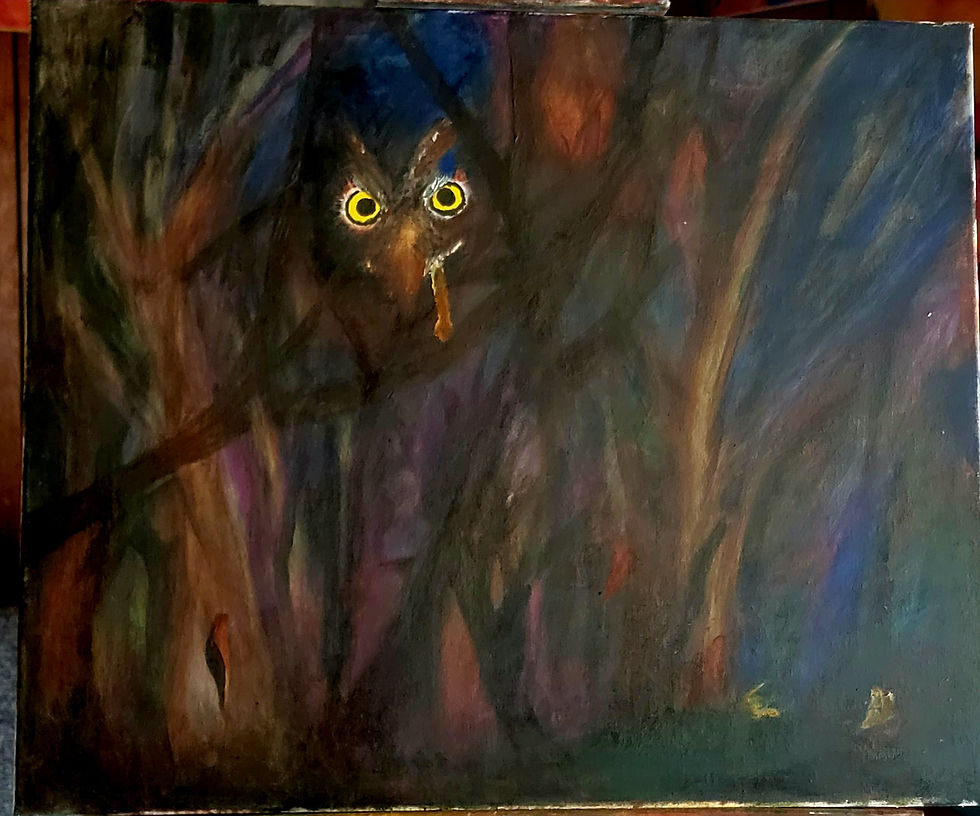
Many people tried to befriend him over the years. He never let them. This isn't a soothing portrait, because he wasn't a soothing bird — vivid, loyal to almost no one, closed to anyone outside the very small circle he chose for himself. This painting holds him exactly as he was: entirely himself, asking nothing of anyone who wasn't already his.
One original. Limited fine art prints available
The Intelligence Behind Pappali
The challenge here wasn't painting a macaw. Macaws are painted constantly — vivid, exotic, decorative. The challenge was painting a specific, known, difficult individual without softening him into something more palatable than he actually was.
Pappali did not perform friendliness. Strangers who looked into his space were not tolerated, and the moment they left, he rearranged everything they'd disturbed — not fear, not distress, but a deliberate restoration of his own order. He bonded with almost no one in twenty-five years, cursed when a promise was broken, and settled only once the ritual of return was honored. That is not the profile of a pet. That is the profile of a being with standards, consistently enforced.
A conventional portrait would have painted him beautiful and left it there — and in doing so, would have lied about him. The intelligence in this painting is in what it refuses to soften: no gentling of the eye, no inviting angle, no warmth extended toward a viewer he would not have extended it to himself. The full-intensity color, the lack of a comfortable entry point for the eye, the directness of the gaze — all of it is accuracy, not style. This is not a painting asking to be liked. It is a painting of someone who was loved by very few, and who never once pretended otherwise.
The understanding here isn't technical. It's relational — knowing a subject closely enough, for twenty-five years, to know that flattering him on canvas would have been the one dishonest thing you could do to his memory..


Comments