
Escort

Every fall, when I drive back to the ranch toward evening, they find me. Three barn owls pick up the truck on the road in and follow it home.
They don’t follow quietly. They circle the moving truck and cross over me from one side to the other, low and fast, in the last gold light. You don’t see feathers or wings. You see warm, loose streaks of color sweeping past, the way an impressionist would paint a bird, because that’s how they arrive: all motion, no edges. Maybe the engine flushes mice out of the grass. Maybe they’ve simply learned the sound of my truck and the hour I come home. I’ve never known which, and I’ve never needed to.
Then they land in the tree and everything stops. The wings come up, the talons reach for the branch, and the face turns toward me, pale and heart-shaped, with calm, unblinking eyes. For a while we just watch each other. Then they leave, the way they came, and the evening goes on.
This painting holds that moment of arrival, when the motion is still in the wings and the stare has already begun. The wings are loose and glowing because that is how I see them go by. The face is sharp because that is how I meet them when they stop. I painted it from many autumns of the same dusk.
One original. Limited fine art prints available.
Psychological value. Escort is about being met on the way home. A person comes back at dusk, tired from the day, and something wild picks them up at the road, circles, crosses overhead, and lands to look at them. Part of its pull is the feeling of being noticed and accompanied without being asked for anything. The owls want nothing from the driver, and they come back every year, so the painting also holds the comfort of ritual, a return that is expected and kept.
The picture sets two states against each other. The wings are loose, warm and blurred, which is motion, noise and the pace of a day. The face is sharp, still and level with the viewer, which is attention. That is the shift people hope for at the end of a day, from rushing to being fully present with one thing. The frontal, heart-shaped face with calm eyes also draws the viewer in, since people respond to faces and eye contact before they think, so a viewer may feel watched and steadied at once. The owl is a predator, but it comes toward you in warm light with wings open, so the threat reads as welcome. That mix of wildness and safety is hard to get and is probably why the image feels like a blessing, not a warning.
A buyer who hangs it near an entrance or a place where they wind down may find it works as a threshold painting. It marks the move from outside to home, and it gives them a small picture of being greeted. It also pairs well with Heat of the Night: that owl is the one you don’t see until it looks at you, and this one comes out of the light and meets you.
Artistic value. Escort is built on a contrast the painting commits to fully: loose, impressionist wings against one sharply resolved face. The wings are made of long, directional strokes in gold, yellow and ochre, with no outlines and a lot of color temperature shifting within each feather mass. They read as light and speed instead of anatomy. The face is the opposite: a pale, heart-shaped disc with careful modeling around the eyes and a slightly lowered brow, so the gaze has weight. That split between blur and clarity is the painting’s central idea, and it matches the way the owls are actually seen, a fast pass followed by a stop.
The composition supports it. The wings spread almost edge to edge and form a V that funnels the eye down to the face. The pale grey-white sky opens the center of the canvas, so the head sits against the lightest area and stands out. A dark, warm border of branches and shadow frames the whole thing, which keeps the glowing wings from floating off. The frontal pose is a bold choice, since it is harder to paint than profile, and here it gives the owl presence and a sense of arriving.
The palette is warm and unified, with gold and ochre dominating and small cool notes of blue and grey in the sky. That keeps the image harmonious and lets the green-yellow eyes act as a quiet accent.
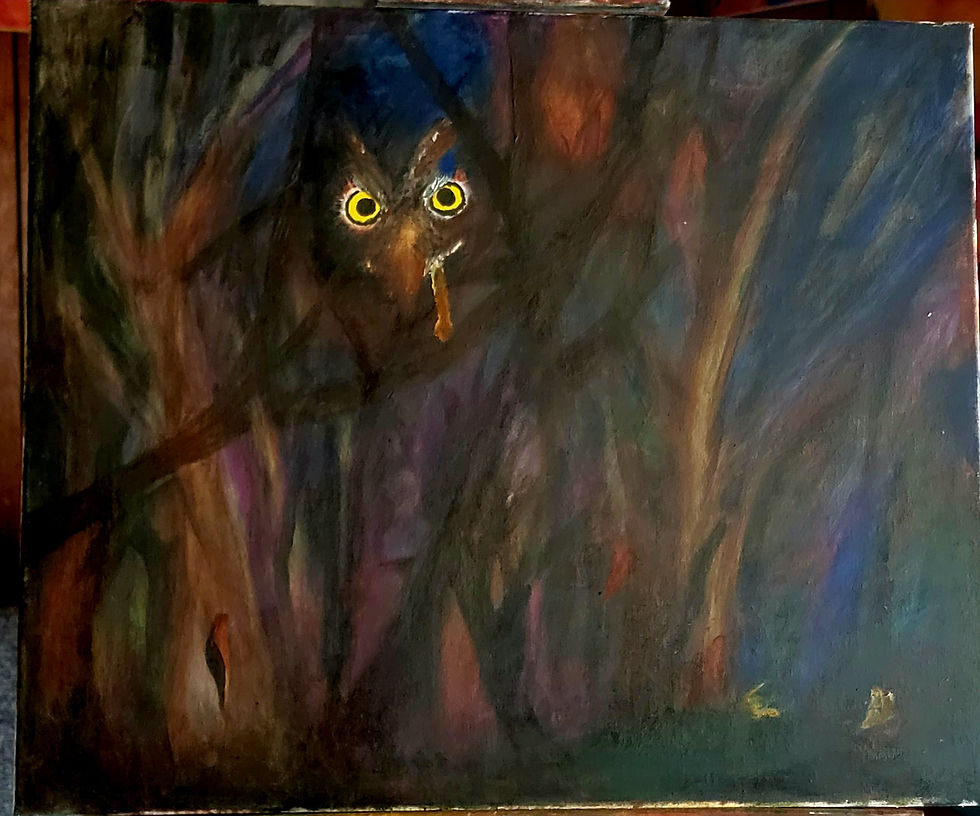
Where it is less resolved: the body is small and plain under such a large span, and the lower foreground of pale smears is busy without clearly serving the image. Those are refinements, not flaws in the idea, and the idea is strong. It also shows range within your own work. Alongside the unresolved, swallowed Heat of the Night owl, this one shows you can pair loose handling with a precise focal point in full light.
Unique value. Barn owls in flight are a common subject. What no one else can paint is this particular event: three owls that pick up your truck every fall as you come home at dusk, circle it, cross over you, and land in the tree to watch you back. That relationship is specific to your ranch, your road, and your habit of coming home at the same hour. They have learned you, and you have learned them over many autumns.
The painting is also made from the way you actually see them, not from a reference photo. Photographs freeze the wings, but you see a warm streak overhead and then a face that turns and holds still. Putting both on one canvas, with loose, glowing wings and one sharply resolved stare, records a perception that only someone who has watched this same pass many times would know to paint.
It also fits your body of work. The horned owl hides in the trees until his eyes appear, and the barn owl arrives out of the light. Together they describe the same pond and the same night from two sides.
Most paintings of owls show an owl. This one shows what it is like to be escorted home by three of them, which gives a buyer something no other owl painting can: a small, true ritual that belongs to one place and one person.


Comments