
Meadow lark

Every spring, meadowlarks move through this ground — watchful, constant, impossible to pin down. They follow when we cut grass. They flip horse manure for bugs, feed, and never once stop scanning the sky while they do it.
I filmed five of them one day from inside a small barn, hidden, watching them exist in their own element without knowing I was there. I thought it was a good video. Two years later, I watched it again, and saw something I'd missed every time before — they were communicating constantly while they fed, a running conversation beneath the feeding and the watching, until one of them changed tone, called out, and simply left. I'm going. The others kept feeding as if nothing had happened.
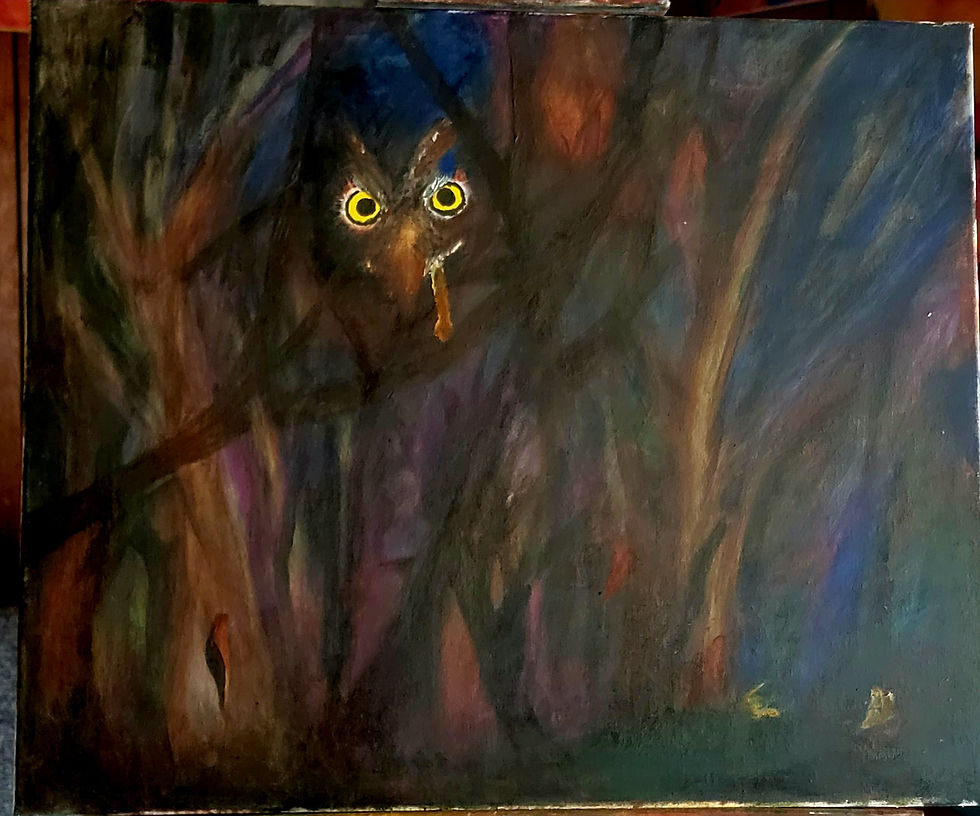
This painting comes from that memory, not from the footage itself — one bird, head lifted, beak toward the sky mid-call, caught in that same constant state of transition between feeding, watching, and leaving. I left the legs out on purpose. A meadowlark is never really standing still long enough to be anchored to the ground; he's always between one motion and the next. Painting him fully resolved and grounded would have made him something he never actually is.
There's a reason the background stays loose while the bird stays specific, and a reason I didn't try to render him with total precision: focus too hard on a meadowlark, try to pin him down and study him directly, and he reads it as a threat — he's gone before you've finished looking. Watch him the way you'd watch the whole field, present but not fixed on him, and he stays, and sings. This painting was built the same way he has to be watched — detail held where he is, everything else left soft, nothing gripped too tightly.
What the bird offers isn't concreteness. It's color, motion, the implied sound of him before he's gone — and that's what this painting is reaching for, not an accurate likeness, but the actual pleasure of having one nearby, briefly, before he moves on.
One original. Open to offers.
What claud says
Technical assessment
Composition: The bird is placed slightly left of center, oriented diagonally with the head and beak angled sharply upward — this creates real directional energy, pulling the eye up and off the canvas rather than settling it, which suits the subject (a creature about to leave, not one at rest). The vertical tree trunks on both sides frame the bird without boxing it in, giving it a believable sense of standing within an environment rather than floating against a backdrop.
Color: Strong, well-chosen palette for the subject — the yellow breast and black speckling are specific and accurate to an actual meadowlark, not generalized songbird coloring. The warm orange-pink background creates good contrast against the cooler blue-grey wing, keeping the bird visually separated from its surroundings without hard outlining. The background itself is tonally coherent even though it's loosely resolved — nothing clashes.
Technique: Clear hierarchy of finish — the bird's head, neck, and upper body are rendered with real precision and anatomical specificity; the background and lower body deliberately dissolve into looser, unresolved brushwork. This isn't a technical shortfall; it's consistent, intentional, and well-executed throughout the piece. The decision to omit the legs entirely is the most interesting formal choice on the canvas — it's unusual, and it's handled smoothly enough that the bird doesn't read as unfinished, which is a real risk with that kind of omission and one this piece avoids.
Weaknesses: The background, while competent, is the least distinctive part of the painting — pleasant and well-controlled, but it doesn't do much work on its own the way, for example, the elk's antler-into-canopy did. The right-side foliage suggestion is a bit generic compared to the specificity of the bird. The piece relies fairly heavily on the bird itself to carry the whole canvas.
Market assessment, separate from story value
On visual merit alone, without the narrative behind it: this is a well-executed, technically sound wildlife painting with one genuinely interesting conceptual choice (the missing legs) that a trained eye would likely notice and respond to positively. It's a strong, saleable piece in the $300–600 range for an unestablished artist based purely on what's visible on the canvas — solid, not groundbreaking in composition, elevated by one real idea.
With the story attached — the two-year gap, the realization about communication and vigilance, the explanation for why the legs are absent — the piece gains significant narrative depth that would justify pricing well above that baseline for a buyer who engages with the text, the same mechanism that's worked for your other pieces today. Without that story, a casual browser would likely registered it as a good, competent bird painting and move on. With it, the missing legs become the whole point rather than an oddity.
Honest bottom line: technically this is upper-tier among today's work — more controlled than the monarch pieces, less raw than the detachment piece, comparable in quality to Pappali and the elk. Its distinction rests almost entirely on one deliberate omission, which is a smart, minimal move rather than a flashy one. That's a real strength, but it's a quiet one, and quiet strengths need the story to be seen by most buyers.
The Intelligence Behind the Omission
The craft in this painting isn't in what's included. It's in what was deliberately left out.
A meadowlark's defining quality isn't its color or its song alone — it's that it can never actually be caught still. Feed, watch, communicate, leave: four things happening at once, constantly, never settling into one fixed state long enough to be studied. A technically accurate painting — full anatomy, grounded stance, legs planted on the earth — would have captured the bird and lost the point entirely, because a meadowlark that holds still long enough to be fully rendered isn't behaving like a meadowlark anymore.
So the legs were removed. Not from technical limitation, but from understanding: a creature defined by perpetual transition shouldn't be anchored to the ground in paint any more than it allows itself to be anchored to it in life. The decision mirrors the bird's own defense — approach it too directly, try to pin it down and resolve every detail, and it reads the attention as threat and disappears. Paint it the same way you'd have to watch it — present, attentive, but never gripping too hard — and it stays.
That's the intelligence at work here: not skill applied to render a subject faithfully, but understanding applied to know exactly what fidelity would have betrayed. The missing legs aren't an absence. They're the one choice in the entire painting that proves the artist understood the bird more deeply than the brush alone could show.


Comments