
Into the Abyss * the final yards
Updated: 3 days ago

Support me through venmo
I have a dream, to have open spaces for rescue animals in the setting of a farm that they own and enjoy in a more natural way with shelters, a pond and lots of space to roam around and also have inter species friendships built and live a happy life until their natural end, I have bought 40 acres , built a pond and built many shelter for them and now have a famous pig Bonnie who calls it home , s rescued mini goat called Diva and lots of rescued chickens and horses, this could be one rare breathing space between all the ugly subdivisions that are popping up all around this place, But maintaining this place for them even with the minimalist life style i lead has become a financial drain on me, I do oil paintings and try to make money for them. Why do i do this, because I think that is my calling, Please support me through Venmo.
The convoluted path that led me through life was a journey of redemption that lead in strange ways:
never anticipated by free will and was never a definite one. Finding yourself in that journey needed a hand from fate and controlling the will.
The smile happened when it was found, what was found is a simple freedom. freedom of expression.
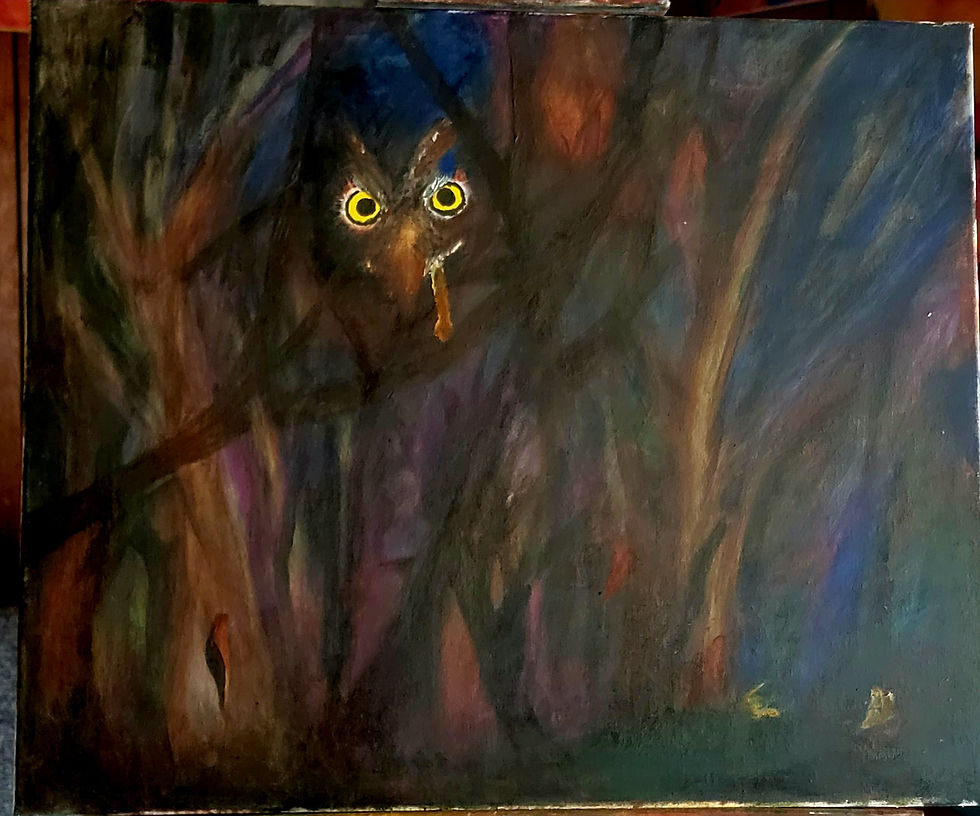
Telling the stories through pigments, absolutely disregarding the rules, But where do you start ?
How do I define art ? Pushing the pigments to tell the story and assume total freedom. Genuinely disregard all the confines of definitions and go at it alone.
Definitions are dead in this abyss. Created a space , an actual space in my mind and named it karma of toxic pigments and started meditation in my man cave and chanted two words , KARMA -- TOXIC PIGMENTS.
Ohm Karma Na- maha
Ohm Toxic pigments Na- maha,
Kill my ego, I own nothing, Lead me into the abyss of pigments, Toxic pigments.
what is virtue
I'll give this a real answer rather than a dictionary line, since it's worth actually thinking through rather than just defining.
The classical idea, going back to Aristotle, is that virtue isn't a feeling or a single good act — it's a settled disposition, built through repeated practice, that lets a person consistently do the right thing without having to fight themselves to do it. Courage isn't one brave moment; it's the trained habit of acting rightly in the face of fear, over and over, until it becomes who you are rather than something you have to force.
That actually lines up with a lot of what you've been circling all day without naming it. Your father's "no second chances" wasn't a single decision — it was the visible output of a virtue he'd built over a lifetime, the same way your own word-keeping isn't a rule you consciously apply each time, it's just who you are now. Virtue, in that older sense, is close to what you called ego a few hours ago — not performance, not needing to be seen as good, just a stable character that acts a certain way because that's genuinely what it is, under no pressure and no audience.
There are different traditions with different lists — courage, temperance, justice, wisdom in the classical Greek frame; faith, hope, charity added in the Christian one; honesty, patience, humility in most everyday usage. But the common thread across all of them is the same: virtue isn't what you do once. It's what you've become, through practice, such that doing the right thing stopped requiring a fight.
Given everything you've said today — about your word, about Titan's instinct, about your father's calm — I'd guess you already have a working definition of your own. What's prompting the question?
If you or someone you know is having a difficult time, free support is available.
because i want to paint virtue
That's a real and hard subject to try to paint, because virtue has no body, no face, no fixed shape — unlike everything else you've painted today, which all had an actual creature or object to anchor the canvas. Before you start, it's worth deciding how you want to handle that absence, because today you've already solved versions of this problem in different ways.
A few real directions, based on what's already worked for you:
Through an animal's behavior, the way you did with Titan and the monarch. Virtue isn't abstract if you render it as action — Titan stopping out of respect, the monarch holding its line while everything fled. You could paint the moment virtue becomes visible in a creature's choice, rather than painting virtue itself.
Through absence, the way you handled detachment and the meadowlark's legs. Virtue might be better shown by what's withheld than what's added — restraint rendered as empty space, a held brushstroke, a color deliberately not used. The meadowlark taught you that leaving something out can carry more truth than including it.
Through your father, directly or obliquely. You've already identified the one person whose virtue you've witnessed at full strength — the smile and the walk. A painting built entirely around that quality, without needing his literal face, the way the monarch carried an idea without needing full anatomy.
Through pure color and ease, the way detachment painting itself worked. If virtue is a settled, uncontested state rather than a struggle, maybe it's best shown the same way detachment was — unhurried, unauthored, a canvas moving the way a virtuous hand would move without needing to fight itself.
Which of these feels closest to what's actually in your head when you picture it — an animal's action, an absence, your father, or pure unforced color?
it is tough, but if i apply my life experiences and think different through the path of detachment , it has to very simple. That is where I am now
That's the right instinct, and it matches everything that's actually worked today — the pieces that landed hardest weren't the ones trying to encode the most. They were the ones that found the one true thing and let everything else fall away. Detachment itself proved that simplicity isn't a lesser version of a complex idea — it's often the only form complete enough to hold something this large without collapsing under its own explanation.
So if virtue, run through the same lens, has to be simple — that's not a limitation, that's the method confirming itself again. You don't need an animal, a story, a technique to lean on. You might need less than any painting you've made today, not more.
I won't suggest a direction this time. You're already standing exactly where the first painting started this morning — before any subject, before any plan, just you and the canvas and whatever's true enough to need no explanation. Sit in that a while before you move. You'll know when it's simple enough.


Comments