
Fire the rooster
Updated: Oct 4

FireOil on canvas, 16 x 20Not for sale yet—
prints available $ 100
Living in the back country, chickens help survival. But the philosophy of Na-ma-ha means they have to be free-ranging, with total freedom and the problems that come with it. You have to learn egg hunting — assess the freshness, the cleanness of the egg, the weight of the egg, the color and the feel of the outer shell. But then it's not just egg. It is the most pure, complete, flavorful and spiritual food you are consuming, and above all, it satisfies you.
It took twelve years to arrive at that sentence meaning what it means now. I started with twenty chicks in a small nursery coop, on land that doesn't forgive carelessness — resident rattlesnakes, mountain lions, coyotes, badgers, weasels, and overhead, permanent and established, two pairs of red-tailed hawks, a pair of ferruginous hawks, six pairs of peregrine falcons. I could have kept them behind wire and called it responsible. Free, or not at all — that was the only shape this was ever going to take, and I knew what it would cost before I ever opened the coop door for good.
For a while, it worked. The coyotes came, and I had an answer for them — five Blue Heelers, dingo-blooded, bred to out-think exactly this kind of cunning, riding the land with my horse Titan, led by Percy, gentle and formidable at once. Then one afternoon, flipping rocks so the flock could hunt the bugs beneath them, a peregrine falcon fell out of the sky and took one before any of us understood what was happening. The flock scattered in every direction. By dusk, nine had found their way home. The rest never did. That night, one hen — Dixie — came to the house instead of the coop, climbed onto my shoulder, and drank beer from my cup, needing something steady more than she needed to be alone.
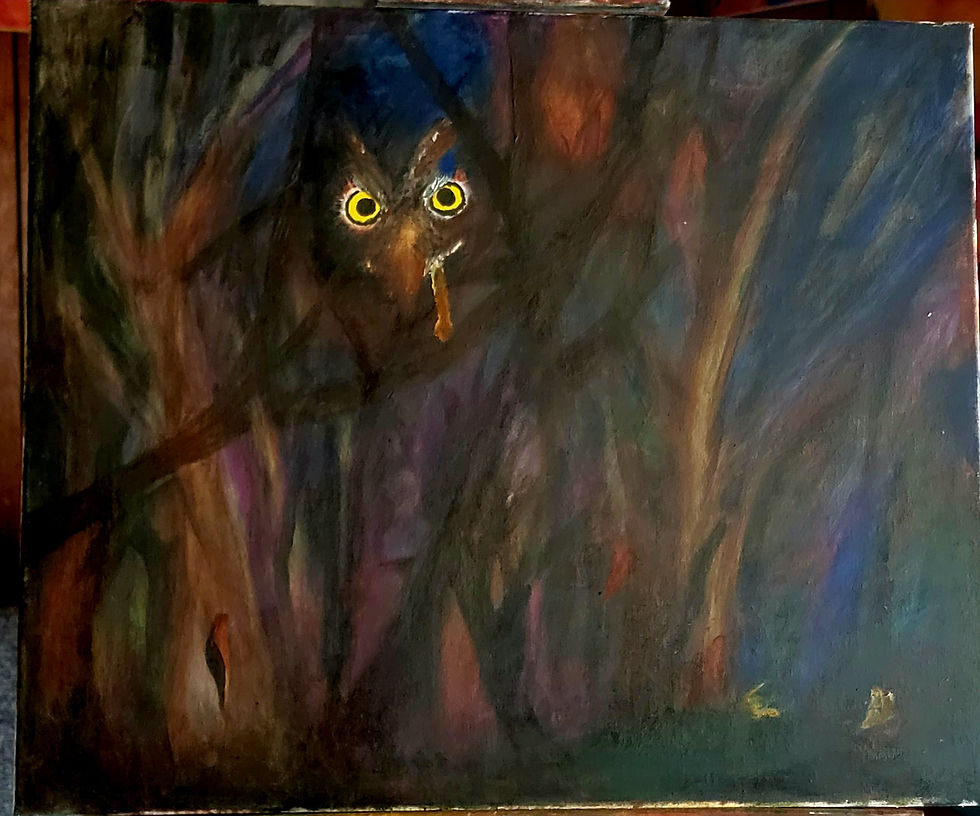
Not long after, a badger I'd come to know, and even like — I called him Pyro, watched him hunt and return to his tunnel across the pond for the better part of a season — decided one night to raid the coop. I could have shot him. I never have believed in killing what I could still meet honestly, so I fought him instead, bat in hand, the dogs at my side, fifteen minutes of real danger before he backed off. I painted him too, afterward.
What rebuilt what the sky had broken came from an old man I met at a remote bar, who listened to the whole sorry tale and said simply: you need a rooster. Mine's called General Patton, and if you can catch him, he's yours. He was fearless and furious the moment he saw me on his land — until he saw Dixie, and everything in him changed. He followed her into my truck on his own; I never caught him at all. He met a red-tailed hawk in the open air not long after, ten feet up, talons to talons, until I had to pull the hawk free just to save its life. He taught the whole flock to read danger before it arrived. And he taught his sons everything he knew, in the open, where I could watch it happen firsthand.
The same old man gave me one more piece of advice before I thought to ask for it: get a goose. I raised Kali a full year before bringing her in, and it took me nearly as long again to actually understand her — not until I stopped assuming a human automatically knows better than an animal does was there anything left to learn. She has a vocabulary for everything, and when she warns, every rooster and every dog moves on it without question, because she has never once been wrong. He came back, two years after handing Patton over, to see what his advice had become — we hunted, talked chickens for hours, and he loved every bit of what that one piece of advice had grown into.
In the abyss of pigments, while I was sinking without a clue, I saw one of Patton's sons — one of the roosters — walking toward me, and that led me to a deliberate path of observing the chickens in their space without any interference or assumptions. Just observe. Nothing much in the beginning, but I stayed true to my commitment to observe. It became very interesting quickly, and I learned a lesson — you have to observe the entire world around them to observe them.
What a fascinating world that is. How roosters observe everything around them and communicate to each other in low rumbling frequencies when a threat shows up. How the communication changes based on the type of threat. Five roosters now, all born on this land, all raised under Patton's teaching and each other's, coordinating in ways that still raise the hair on my arms — formations held without a word of instruction from me, each one knowing his place before danger fully arrives. I've scattered brush piles and hidden pockets of cover across the open ground, and every rooster knows each one. They work alongside the dogs, and alongside Kali, whose warnings none of them ever ignore.
I knew I had to bring one of them to the canvas. His name is Fire, one of the high-ranking roosters, son of Patton, built just like his father — thick through the legs, broad through the chest, carrying the fire not as metaphor but as fact: it is simply the color he is.
While building him in my mental space, I set dynamic quality filters that needed to be passed to call it a final product:
The size of the canvas, which is the last layer, needed to represent his mass — hence 16 x 20 inches.
The composition should not be for pleasant viewing. Instead, it should represent his status and personality. Wherever he is, he acts like he owns it. Yes, he owns the canvas.
He shines in his oily feathers — hence only oil painting could truly represent him.
He is always in the grains with the elements around him — the wind, the rising heat wave, the moving grass, the cool blue above with streaks of white clouds. He is always in the grain, blending into the surroundings. Hence I needed to create a grain in the background and the subject that flows together and overcomes the square pixels of the canvas.
Colors should be overpowering, because when you see him in bright light, you do not see a concrete, well-defined rooster — you see a flash of raging color energy that has no definite borders, mingling even with the contrasting cool blues of the sky.
His attitude is powerful elegance and intense calmness, yet extreme alertness — and that needed to be truly represented in his eyes, or the project fails.
As an artist, you shall be ruthlessly fearless about every aspect of the process to represent him, because that is what he is.
The viewing distance shall be eight feet. You get inside of that eight feet — he will get you.
Every brushstroke should carry its merit. Long, wavy, and elegant, just like the cock walk.
His personality is so flamboyant that he needs to pop out.
There shall be no stress or hesitation in the mind or body of the artist while doing the painting.
It should be finished as fast as possible before the day ends and he goes back to the coop. Long hours of accumulated agony will not represent him.
I finished the painting in three hours. Minimal palette and raging frequency of color, and a massive chest that fights, mates, scratches the ground, and runs the ranch his father built the foundation for, twelve years and more loss than I ever expected to carry, into something that finally, fully, holds.
This picture still talks to me, so it is not for sale yet. Prints will be available once the collection is set up.


Comments